What is the bidding model
The AI bidding model is the Catchbase feature that manages Apple Ads bids for you on a per-keyword basis. You set the campaign objective, target, and daily budget. The bidding model decides what each keyword should bid, updates those bids continuously, and keeps the campaign inside the boundaries you configured.
Before you start
- Apple Ads integration connected.
- At least one campaign active in Catchbase with a target and a daily budget set.
- An MMP connected if your objective depends on in-app events or revenue.
How the bidding model fits into the workflow
The work of running an Apple Ads campaign splits into two parts. The first is strategy: what are you trying to achieve, how much are you willing to spend, and what does success look like for a single user. The second is execution: given those goals, what should each keyword bid in every auction. The bidding model handles the second part so that you can focus on the first.
In practical terms, you configure three things per campaign:
- The objective, which is either a volume goal (installs or a counted in-app event) or a revenue goal (ROAS against MMP revenue).
- A target, expressed as a cost-per-objective or a ROAS percentage.
- A daily budget.
From there, the bidding model sets and revises keyword-level bids inside the campaign. It does not change your targets, your budgets, or your keyword list. It learns from the campaign's recent performance, the interplay between your target and your budget, how competitive each keyword is, and how previous bid moves translated into installs and revenue. Two keywords with the same current cost can receive different bid updates because the model expects them to behave differently as bids move up or down.
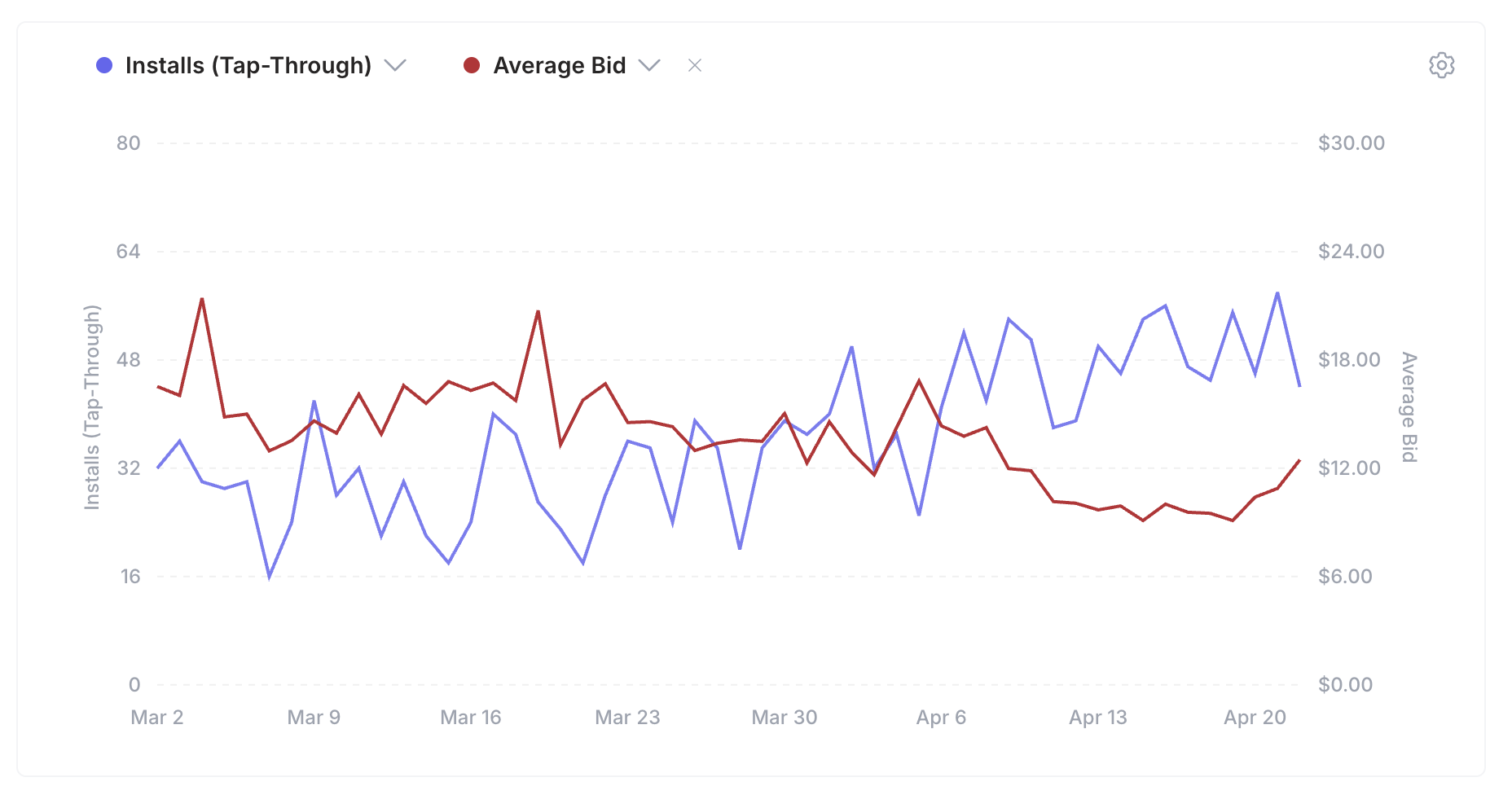
What the bidding model does, in one paragraph
The bidding model is a reinforcement-learning system trained on Apple Ads. Rather than forecasting the single "correct" bid for a keyword, it decides, keyword by keyword, whether the next bid should go up, go down, or stay where it is. Decisions take into account how the keyword is performing against the target, how much of the budget has been spent, and how competitive the auctions have been. The deep dive below explains the methodology in full.
What the bidding model is not
- It is not a rule engine. You do not write if-then statements; you set an objective and a target.
- It does not pick keywords for you. That is handled by Keyword Mining.
- It does not reallocate spend across campaigns. That is handled by Budget Allocation.
- It does not change the objective or target on its own. Those stay under your control.